Choosing a Paver Pattern That Actually Holds
Patterns aren't decoration. Let me say that again: patterns aren't decoration. The way you lay your pavers determines how they distribute load, resist shifting, and handle traffic. My father laid herringbone on every driveway he ever touched. He wasn't being fancy. He was being smart.
Herringbone — The Gold Standard
If you're paving a driveway, a parking area, or anything that takes vehicle traffic, herringbone is the answer. Period. The 45-degree or 90-degree interlocking pattern creates a mechanical bond between pavers. Each brick is wedged against its neighbors in a way that disperses weight across the entire field. When a car tire rolls across herringbone, the load doesn't concentrate — it spreads. That's physics doing its job.
Herringbone takes more cuts. More time. More material. I don't care. If you're paving for vehicles and don't use herringbone, you're rolling the dice. And those dice are loaded against you. For professional paver installations, herringbone is the standard for a reason.
Running Bond — The Workhorse
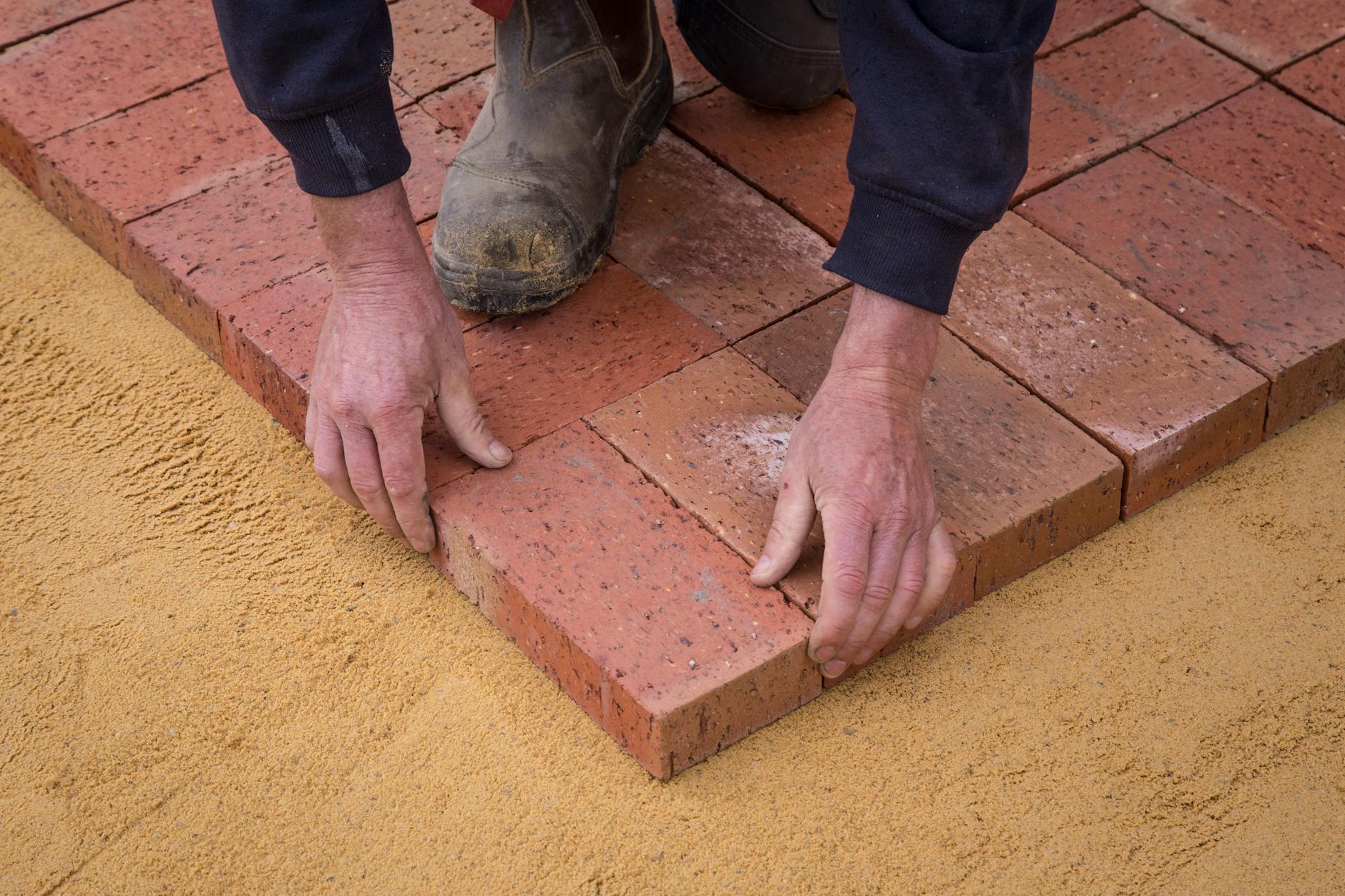
Running bond is your standard offset pattern — like a brick wall turned sideways. Each row is staggered by half a brick. It's clean, simple, and works great for walkways, patios, and light-use areas. It doesn't interlock as tightly as herringbone, so it's not ideal for driveways. But for a garden path or patio where nobody's parking a truck? Running bond is honest work.
Run it lengthwise along the primary direction of travel. This keeps the joints from lining up with foot traffic, reducing the chance of individual pavers rocking or settling.
Basket Weave — The Classic Look
Basket weave is pairs of bricks set perpendicular to each other, alternating in a checkerboard-like grid. It looks good. Homeowners love it. For a low-traffic patio or courtyard with no vehicle access, it's fine. But honestly — it's one of the weaker patterns structurally. The joints line up in long runs, creating natural fault lines that become paths for shifting under load.
I'll lay basket weave for decorative areas. I won't lay it for anything taking real weight or heavy foot traffic. That's responsible work.
Stack Bond — Use It Carefully
Stack bond is bricks in a straight grid. No offset. Every joint lines up vertically and horizontally. Modern-looking. Architects love it. Structurally, it's the weakest pattern you can choose. Every joint is a continuous line running the full field. Under lateral pressure, those joints are seams waiting to open.
I've laid stack bond on interior floors, accent borders, and decorative panels where pavers are fully contained with no structural load. I'd never use it on a driveway, and I'd think hard before using it on a walkway.
The Decision
Here's the rule my father gave me: Match the pattern to the purpose. Not the Pinterest board. A herringbone driveway that lasts 25 years is more beautiful than a stack bond driveway that buckles in 5. Beauty in masonry is something that lasts. Everything else is just a picture.