Lay It Right the First Time — Paving Basics
Let me tell you something my father said to me when I was thirteen, watching him excavate a walkway by hand. He said, "The brick isn't the job. The ground underneath is the job." I didn't understand it then. I do now. I've been doing this for 38 years, and I've seen more paver jobs fail because of bad base prep than I can count.
Start with the Dirt — Excavation
Before a single brick touches the ground, you need to dig. And I don't mean scuff the topsoil. You're removing a minimum of 7 to 8 inches of material for a walkway, 10 to 12 for a driveway. You're going below the organic layer, below the topsoil, down to stable subgrade. If you skip this step or cheat it by a couple inches, your pavers will shift. They'll settle unevenly. You'll have puddles, trip hazards, and a job you'll rip up in three years.
Grade your excavation. Water needs somewhere to go. A 1% slope — about an eighth of an inch per foot — away from any structure. Use a string line and a level. Don't eyeball it. I don't care how experienced you are. Use the string line.
The Base — Where It All Lives or Dies
Your base is crushed stone. Specifically, you want processed gravel — 3/4-inch down to fines. Some guys call it crusher run, some call it road base. Don't use pea gravel. Don't use round stone. It shifts. You need angular material that locks together when compacted.
Lay it in lifts — 2 to 3 inches at a time — and compact each lift with a plate compactor. Not a hand tamper. A plate compactor. You're building a foundation here, not patting down a sandbox. Your total compacted base should be at least 4 to 6 inches for a walkway, 8 to 10 for a driveway. If you need professional brick paver installation, consult an experienced mason.
Sand — The Setting Bed
On top of your compacted base goes a layer of coarse concrete sand, screeded flat to exactly 1 inch. Not 2 inches. Not "about an inch." One inch. Use two 1-inch conduit pipes as screed rails. Lay them on the base, fill sand between and around them, then drag a straight board across the pipes to level it perfectly. Pull the pipes out, fill the voids, and don't walk on it.
This sand layer is not structural. It's there to fill the tiny imperfections in your base and give the brick a uniform bed. If your sand layer is doing structural work, your base failed.
Laying the Brick
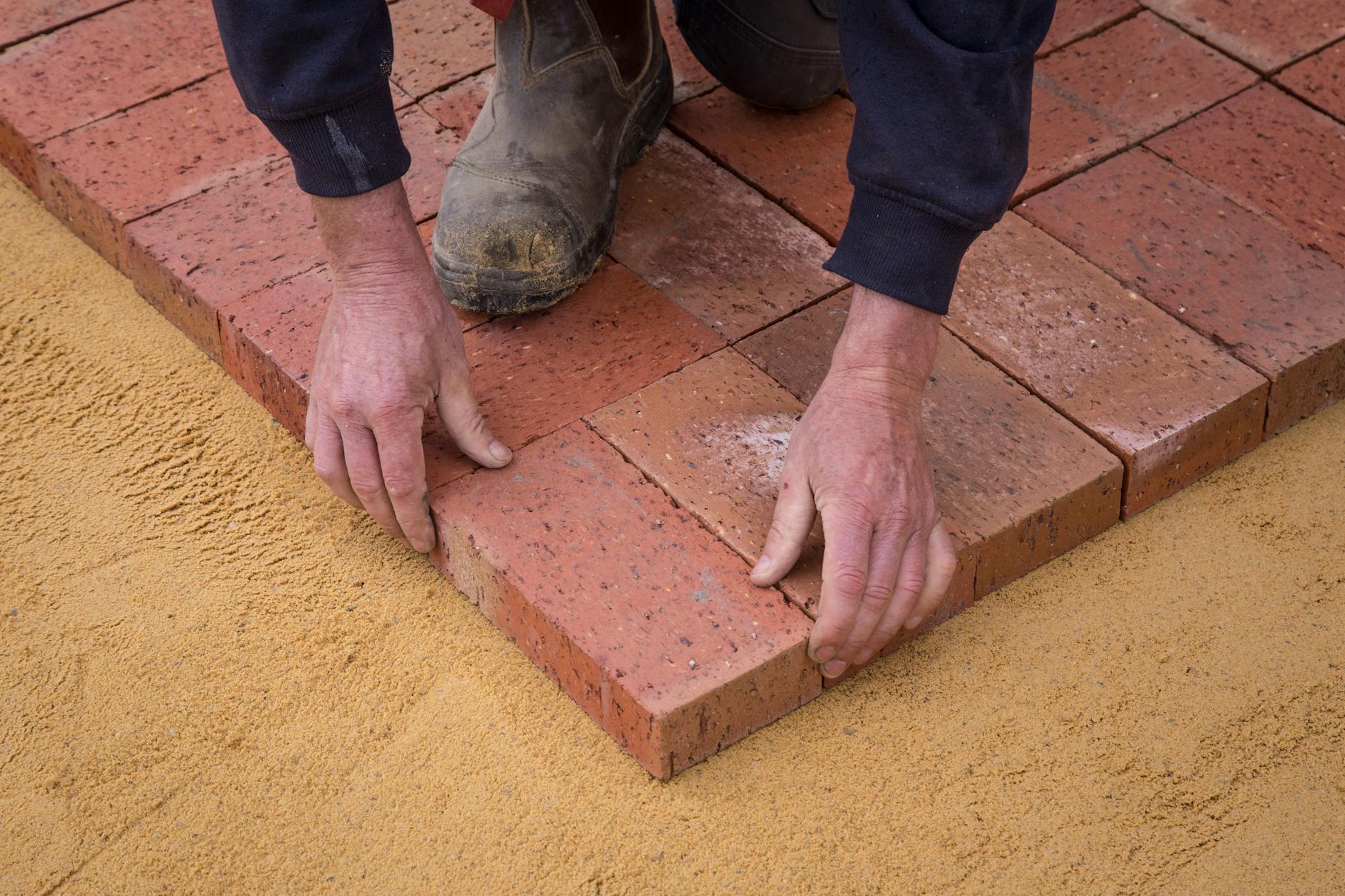
Start from a straight edge — a wall, a curb, a snapped chalk line on the sand. Place each brick straight down. Don't slide it. Don't drag it through the sand bed. Set it and leave it. Work outward. Keep your joints tight — an eighth of an inch is all you want.
When you've got your field laid, set your edge restraint. This is non-negotiable. Without edge restraint, the entire paver field will spread and separate like a deck of cards on a table. Spike it every 12 inches into the base. Then spread polymeric sand over the surface, sweep it into every joint, mist it, and let it set.
The Final Truth
A good paver job is 80% preparation and 20% laying brick. My father used to spend two full days on base prep for a walkway that took him half a day to pave. People thought he was slow. His walkways are still flat. Theirs aren't. That's the lesson.